Care
Is silk antibacterial? What the studies tested and what they did not
You will often see silk sold as naturally antibacterial, but no study we found backs that up. We went looking for the test behind the claim. Nobody has tested plain woven mulberry silk for resisting bacteria, as far as we could find. The silk fabrics that did cut bacteria in studies had something added to them. Here is what was tested, what was not, and what actually keeps a pillowcase clean.
Is silk naturally antibacterial?
No study shows that it is. We searched for a test of untreated woven mulberry silk, the kind a pillowcase is made from, and found none. That means silk on its own, with nothing added to it.
That does not mean silk is a problem. It means nobody has measured it. A claim that a fabric resists bacteria is a claim about something you cannot see, so it needs a test to stand on. For plain silk, that test does not exist yet.
So "naturally antibacterial", "antimicrobial" and "resists bacteria" are all on our list of claims we don't make.
What did the silk studies actually test?
Look closely at the fabrics behind the research and the same thing keeps turning up: an antimicrobial finish. A finish is a treatment applied to the fabric. It is not part of the silk.
- DermaSilk. The silk in most eczema studies is a specialist knitted silk, made sericin-free, with an antimicrobial finish added. It is made for clothing, not woven into a pillowcase.
- The Wake Forest pillowcase trial. This pilot, run in 2008 and 2009, gave 40 adults with acne either a "silk-like" pillowcase or a cotton one for 12 weeks. The silk-like fabric was not silk. It was half polyester, half nylon, with an antimicrobial finish added. It did no better than cotton.
- A back acne pilot. In 2017, 14 patients wore DermaSilk T-shirts for 6 weeks. The silk carried the added antimicrobial, and there was no comparison group.
The most useful study is the one that pulled the two apart. In 2008, Stinco and colleagues ran a double-blind trial in 30 people aged 3 to 31 with eczema. Both groups wore the same specialist silk. One group's silk had the antimicrobial finish and the other group's did not. Both groups improved, but the group with the finish kept improving. That suggests the finish did part of the work, not the silk alone.
It was an eczema trial on clothing, not a test of a pillowcase. We look at what silk can and cannot do for skin in is silk good for eczema and sensitive skin, and at the Wake Forest trial in more detail in silk pillowcases and acne.
What about lab studies on silk proteins?
Some claims online point to laboratory work on silk proteins. That research is real, but it is not about fabric. It covers things like fibroin dissolved into solutions, sericin extracted from raw silk, and silk membranes loaded with silver. None of it is evidence for a pillowcase.
Take one 2022 study of silk fibroin and sericin membranes, made for wound healing after mouth and jaw surgery. The bacterial reduction in that work came from the silver added to the membranes, not from the silk.
Sericin needs a word of its own. Raw silk is two proteins. Fibroin is the fibre itself. Sericin is the gum that holds the strands together, about 25 to 30% of the protein. Sericin is washed out in degumming before smooth silk fabric such as charmeuse is woven, so a finished silk pillowcase is mostly fibroin. A lab result for a sericin extract says nothing about a fabric that has had its sericin washed out.
Our guide to what mulberry silk is explains how silk is reeled and finished, and the fibre section of our science page lists the sources.
Is a silk pillowcase more hygienic than cotton?
Nobody has shown that. We found no study comparing bacteria on silk and cotton pillowcases, or how clean each stays over a week of sleep. Without that, "more hygienic than cotton" is a guess, and we will not print a guess.
What every pillowcase has in common, silk, cotton or satin, is that it needs washing. That part is not in doubt.
How do you keep a silk pillowcase clean?
Wash it every week, whatever it is made of. It is the advice we give for every pillowcase, and the one thing on this page that does not wait on a missing study.
Silk asks for a little more care in the wash, because the wrong products weaken it:
- Use cool water, by hand or on a delicate cycle inside a mesh bag.
- Use a pH-neutral detergent with no enzymes or bleach. Strong alkaline detergents weaken silk.
- Skip the tumble dryer. Lay it flat or hang it to dry.
- Dry it out of direct sun. Sunlight fades silk and yellows white silk.
- Check the care label on your pillowcase first.
Our guide on how to wash a silk pillowcase goes through it step by step, and the care questions on our FAQ cover drying and ironing too.
What does SOIEA say about silk and bacteria?
Nothing, beyond how to wash it. UK advertising rules say a business must hold documentary evidence for a claim before it makes it. A lab test can back a claim about the fabric itself, in a named test. It cannot back a claim about what happens to your skin. For plain woven silk there is not even the lab test, so "antibacterial", "antimicrobial" and "more hygienic" stay off our pages.
The short version on our science page grades this claim alongside every other one, with the sources listed.
SOIEA is 100% mulberry silk at 22 momme, in champagne and blush, launching in December 2026 for the UK and Ireland. It is smooth and soft against your skin. Choose it because you love how it feels. See the pillowcase.
Questions people ask
No study shows that plain woven silk kills or resists bacteria. In the studies where silk fabrics reduced bacteria, an antimicrobial finish had been added to the fabric.
Nobody has tested that. We found no study comparing bacteria on silk and cotton pillowcases. Whatever your pillowcase is made of, wash it every week.
Lab work on sericin extracts is not evidence for a pillowcase. Sericin, the gum that holds raw silk together, is washed out in degumming before smooth silk fabric is woven, so a finished silk pillowcase is mostly fibroin.
A treatment added to the fabric. The specialist silk used in eczema studies carries one, and a 2008 trial comparing the same silk with and without it suggests the finish did part of the work.
Every week, in cool water with a pH-neutral detergent that has no enzymes or bleach. Dry it flat or hanging, out of direct sun, and never in a tumble dryer.
Sources
- Stinco G, Piccirillo F, Valent F. A randomized double-blind study to investigate the clinical efficacy of adding a non-migrating antimicrobial to a special silk fabric in the treatment of atopic dermatitis. Dermatology, 2008
- Wake Forest University. Efficacy of silk-like bedding fabric pillow case in the treatment of acne vulgaris. ClinicalTrials.gov NCT00767104
- Schaunig C, Kopera D. Silk textile with antimicrobial AEM5772/5 (Dermasilk): a pilot study on acne vulgaris on the back. Int J Dermatol, 2017
- Schäfer S, Smeets R, Köpf M, et al. Antibacterial properties of functionalized silk fibroin and sericin membranes for wound healing applications in oral and maxillofacial surgery. Biomater Adv, 2022
- Aad R, Dragojlov I, Vesentini S. Sericin protein: structure, properties, and applications. J Funct Biomater, 2024
- Zhu L, Lin J, Pei L, et al. Recent advances in environmentally friendly and green degumming processes of silk. Polymers, 2022
- Ohio State University extension. Silk fabric care fact sheet
- ASA and CAP. Substantiation for health, beauty and slimming claims
Every claim here is checked against the published sources above and our graded evidence page. We don't make claims the evidence doesn't support.
Keep reading
Care
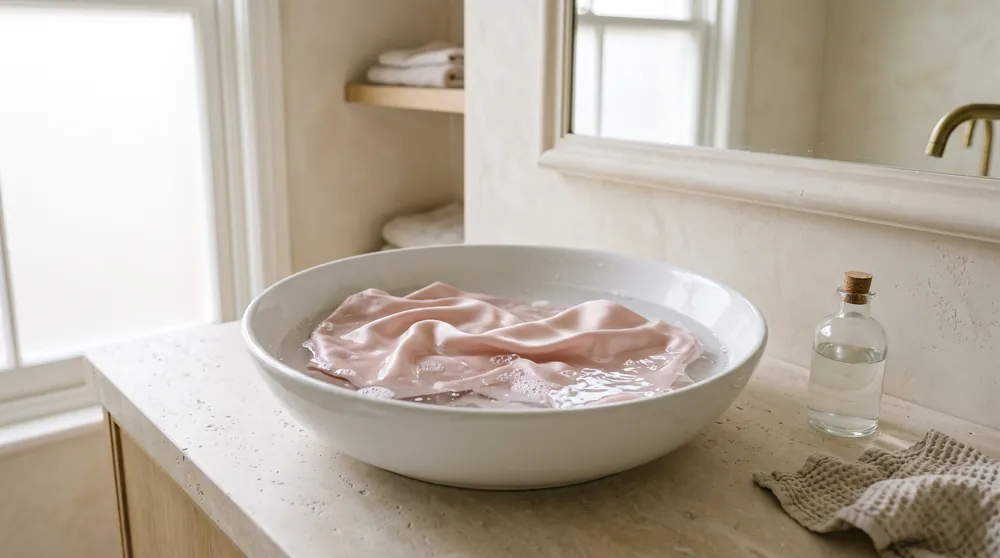
How to wash a silk pillowcase without ruining it
Wash it every week in cool water, by hand or on a delicate cycle inside a mesh bag, with a pH-neutral detergent that has no enzymes or bleach. Skip the tumble dryer. Lay it flat or hang it to dry out of direct sun, which fades silk. Check your care label first.
· 4 min read
Sleep
Does silk keep you cool at night? Temperature and sleep comfort
No study has tested whether a silk pillowcase keeps you cool or helps you sleep. The only sleep temperature study we found used silk-filled quilts, not pillowcases. Silk does hold about 11% of its weight in moisture from the air, far more than polyester satin. Beyond that, we describe silk as it feels: light, smooth and natural.
· 5 min read

Sleep
Are silk pillowcases hypoallergenic? Dust mites and allergens
No study shows that a silk pillowcase is hypoallergenic or keeps dust mites away. Silk proteins are documented allergens, though reactions to finished woven silk appear rare. Mites live mainly in the pillow filling, which a pillowcase does not seal. So we do not call SOIEA hypoallergenic. Wash your pillowcase every week, whatever it is made of.
· 4 min read
Be first to sleep on it.
22 momme mulberry silk, launching December 2026. Shipping to the UK and Ireland.
Join the pre-order list