Skin
Is silk good for eczema and sensitive skin? What the evidence shows
If you live with eczema, or with skin that reacts to almost everything, you will have seen silk sold as the answer. Some of that comes from real studies. The biggest and most careful of them found no real benefit, though, and none of them tested a pillowcase. Here is what was studied, what it found, and what we can honestly say about silk and your skin.
Is silk good for eczema?
The best evidence says it makes no real difference. The largest trial is the CLOTHES trial, run in the UK and published in PLoS Medicine in April 2017. It took 300 children aged 1 to 15 with moderate to severe eczema, from five UK centres. One group wore specialist silk garments on top of their usual care. The other had their usual care alone. Each child was followed for 6 months, and the nurses who scored the eczema did not know which group the child was in.
Eczema severity did not differ between the groups in any way that mattered. The authors called the difference "not clinically important" and concluded that "silk clothing is unlikely to provide additional benefit over standard care."
They were fair about the limits of their own work. They noted that scoring the eczema by an objective measure "may have underestimated treatment effects". Even so, it is by far the largest trial we found, and it found no benefit worth having.
The NHS reads it the same way. NHS England's guidance on items that should not routinely be prescribed in primary care tells prescribers not to start silk garments for any patient, as products of low clinical effectiveness. Local NHS bodies follow it and cite the CLOTHES trial. Guidance from Hertfordshire and West Essex puts it plainly: "silk garments should not routinely be prescribed".
Why do some older studies say silk helps?
Several small studies, most of them before CLOTHES, reported good results, mostly with a specialist fabric called DermaSilk. They were small and short. One followed 46 children for a week, and nobody was blinded to which fabric each child wore. Others had 15, 22 or 30 people. One had no comparison group at all.
A systematic review in 2013 looked at 13 studies of fabrics for eczema. It rated the case for silk as "weak", on "low quality of evidence". A 2020 review of fabrics for eczema described the evidence for silk as "mixed", while calling silk "generally safe".
Small, short studies without blinding often look better than large, careful ones. When the large, careful trial came, the benefit was not there.
Did any of the studies use a silk pillowcase?
No. This is the detail most articles leave out. Every eczema study we found used specialist clothing made from knitted silk with the sericin removed, often with an antimicrobial finish added. DermaSilk is made this way. None tested a woven mulberry silk pillowcase.
The finish seems to matter. A 2008 double-blind study tested the same silk with and without its antimicrobial finish, and the finish made a difference. So part of what the earlier studies saw may have come from the finish rather than the silk.
That means a result for treated clothing cannot be borrowed for a plain silk pillowcase. It cuts both ways. CLOTHES does not prove that a pillowcase does nothing. It does mean nobody has shown that one helps eczema. We looked at the same problem with acne in silk pillowcases and acne, where the only trial used a synthetic fabric.
Is silk good for sensitive skin?
No study has tested a silk pillowcase on sensitive skin. What there is: silk is a smooth filament fibre, the small eczema studies found little irritation, and reviews call silk fabric generally safe. Being safe to wear is not the same as being shown to help.
So the honest description is a sensory one. Silk is smooth and soft against your skin. We will not tell you it soothes sensitive skin, or that it is recommended for sensitive skin, because nothing shows that. Both are on our list of claims we don't make.
If harmful substances in fabric are what worries you, OEKO-TEX Standard 100 is a label worth knowing. It means every part of a textile has been tested for harmful substances, and certificates can be checked by number on the OEKO-TEX site. It is a test of the fabric, not of what the fabric does to your skin.
Can you be allergic to silk?
Yes, though it is rare. Silk proteins are documented allergens. Most reported cases involve silk filling in quilts and silk waste, not finished woven fabric. There are also single case reports, such as hives from a silk shirt in a person with atopic skin.
Sericin, the gum that holds raw silk together, is a known allergen, and it is why the specialist eczema silks are made sericin-free. In smooth woven silk such as charmeuse, sericin is washed out in degumming before weaving, so the finished fabric is mostly fibroin. Our guide to what mulberry silk is explains how.
Rare is not the same as hypoallergenic. No test of plain woven silk supports that word, so you will not see it from us.
What can you do about your pillowcase?
For the eczema itself, your GP, a pharmacist or a dermatologist is the right person to ask. A pillowcase is not a treatment, and we will not sell ours as one.
For your bedding, wash your pillowcase every week, whatever it is made of. If you sleep on silk, use cool water and a pH-neutral detergent with no enzymes or bleach, and skip the tumble dryer. Our guide on how to wash a silk pillowcase goes through it, and the eczema section of our science page sets out the trials with their sources.
SOIEA is 100% mulberry silk at 22 momme, in champagne and blush, launching in December 2026 for the UK and Ireland. It is smooth and soft against your skin, and that is the claim we make. See the pillowcase.
Questions people ask
No. Every study we found used specialist knitted silk clothing with the sericin removed, often with an antimicrobial finish added. None tested a woven mulberry silk pillowcase.
Not routinely. NHS England lists silk garments among items that should not routinely be prescribed in primary care, as products of low clinical effectiveness, and local NHS guidance cites the CLOTHES trial.
No. DermaSilk is a knitted, sericin-free silk with an antimicrobial finish, made as clothing for eczema. A silk pillowcase is a woven fabric, often a charmeuse weave.
No test of plain woven silk supports that. Silk proteins are documented allergens in rare cases, mostly from silk filling and waste rather than finished woven fabric.
No study has shown that any pillowcase fabric helps eczema. Wash yours every week, whatever it is made of, and ask your GP, a pharmacist or a dermatologist about the eczema itself.
Sources
- Thomas KS, Bradshaw LE, Sach TH, et al. Silk garments plus standard care compared with standard care for treating eczema in children (CLOTHES). PLoS Med, 2017
- Thomas KS, et al. Randomised controlled trial of silk therapeutic garments for the management of atopic eczema in children: the CLOTHES trial. Health Technol Assess, 2017
- Ricci G, Patrizi A, Bendandi B, et al. Clinical effectiveness of a silk fabric in the treatment of atopic dermatitis. Br J Dermatol, 2004
- Stinco G, Piccirillo F, Valent F. A randomized double-blind study to investigate the clinical efficacy of adding a non-migrating antimicrobial to a special silk fabric. Dermatology, 2008
- Lopes C, Silva D, Delgado L, Correia O, Moreira A. Functional textiles for atopic dermatitis: a systematic review and meta-analysis. Pediatr Allergy Immunol, 2013
- Jaros J, Wilson C, Shi VY. Fabric selection in atopic dermatitis: an evidence-based review. Am J Clin Dermatol, 2020
- Hertfordshire and West Essex ICB. Silk garments, prescribing guidance
- Pan Mersey Area Prescribing Committee. Silk garments for eczema or atopic dermatitis, policy statement, 2020
- Johansson SG, Wüthrich B, Zortea-Caflisch C. Nightly asthma caused by allergens in silk-filled bed quilts. J Allergy Clin Immunol, 1985
- Vandevenne A, Morren MA, Goossens A. Immunological contact urticaria caused by a silk shirt in an atopic patient. Contact Dermatitis, 2015
- Zhu L, Lin J, Pei L, et al. Recent advances in environmentally friendly and green degumming processes of silk. Polymers, 2022
- OEKO-TEX, STANDARD 100
Every claim here is checked against the published sources above and our graded evidence page. We don't make claims the evidence doesn't support.
Keep reading
Skin
Do silk pillowcases help acne? What the only trial found
No study has shown that a silk pillowcase helps acne. The only completed pillowcase trial used a polyester and nylon fabric sold as silk-like, not silk, and it did no better than cotton. A trial of real mulberry silk was registered in 2023 and has not reported. Whatever your pillowcase is made of, wash it every week.
· 4 min read
Skin
Do silk pillowcases stop wrinkles? An honest look at sleep lines
No study shows that a silk pillowcase prevents or reduces wrinkles. Sleep lines come from your face pressing into the pillow when you sleep on your side or front, and a pillowcase does not change that pressure. Sleeping on your back helps most. Silk gives your face a smooth, soft surface to rest on.
· 4 min read
The fibre
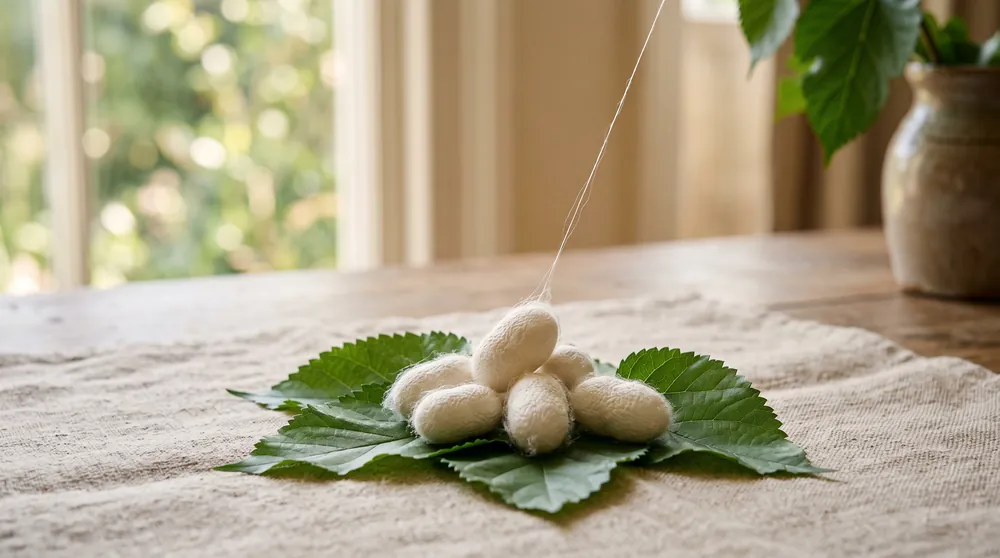
What is mulberry silk, and why is it reeled not spun?
Mulberry silk comes from silkworms fed on mulberry leaves. Each cocoon is unwound, or reeled, as one long continuous filament, so the yarn has no short fibre ends on its surface. Spun silk is made from short fibres, more like cotton yarn. Silk itself is a natural protein fibre, made mostly of fibroin.
· 4 min read
Be first to sleep on it.
22 momme mulberry silk, launching December 2026. Shipping to the UK and Ireland.
Join the pre-order list