Sleep
Does silk keep you cool at night? Temperature and sleep comfort
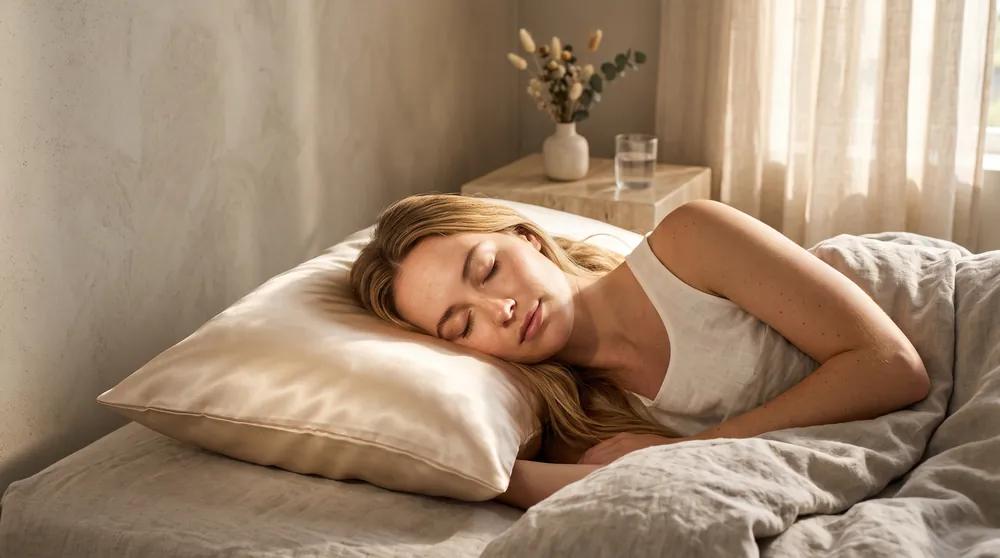
Silk has a reputation as the fabric for hot sleepers. It is often sold as cooling, breathable, even "cool in summer, warm in winter", but no study we found shows any of that for a pillowcase. We went looking for the research. There is one study of silk and sleep temperature, and it was about quilts. Here is what it found, what is known about silk and moisture, and what we can honestly say.
Does a silk pillowcase keep you cool at night?
No study shows that it does. We searched for research on silk pillowcases and sleep temperature, and on silk pillowcases and sleep quality, and found none. A search of the medical literature for silk, sleep and bedding turns up two papers, and neither is about this.
That does not mean silk feels warm. It means nobody has measured it. A pillowcase is a thin layer under your head and face. Whether it changes how warm you feel through the night is a fair question, and for now there is no answer.
So we will not tell you that SOIEA regulates your temperature, keeps you cool or helps you sleep. All three are on our list of claims we don't make.
What did the silk quilt study find?
The one study we found comes from Jiangnan University in China, published in the journal Indoor Air in 2022. In it, 16 adults slept whole nights under three kinds of quilt: down, silk-filled and polyester, each at six filling weights. The researchers compared the room temperatures people found comfortable under each one.
When the quilts gave the same insulation, the comfortable room-temperature limits came out highest for silk, then down, then polyester. Put simply, under the silk quilt people stayed comfortable in warmer rooms than under the other two.
It is an interesting result, and it is the closest the research gets. But look at what was tested. The silk in that study was floss filling inside a quilt, not a woven fabric. A quilt covers most of your body. A pillowcase is a thin woven layer under your head. A result for one cannot be borrowed for the other, and we will not borrow it.
Is silk cool to the touch?
Silk is often described as cool to the touch, especially when you first lie down. A bedding brand quotes a commercial cool-to-touch test that puts silk ahead of cotton. It has not been published, and we found no independent comparison of silk and cotton pillowcase fabric on this measure.
So we cannot tell you, as a fact, that silk feels cooler than cotton. What we can say is sensory, and it stays sensory. Silk is light, smooth and natural. How it feels when you lie down is yours to judge.
Is silk breathable?
You will often see silk called "breathable", but the word is contested and no test of a silk pillowcase backs it, so we do not use it.
Here is what is known about silk and moisture. Moisture regain is how much water vapour a fibre holds from the air, as a share of its dry weight. In standard conditions, 21°C and 65% humidity, silk takes up about 11% of its weight. Cotton takes up 7 to 11%, and polyester 0.4 to 0.8%. So silk holds about as much moisture from the air as cotton, and far more than polyester satin. Our post on silk, cotton and moisture goes through the figures.
Moisture from the air is not the whole story. A small physiology study at Nagasaki University put patches of cotton, silk and nylon over sweating skin. The amount of sweat did not differ between them. The fabrics slowed changes in humidity and evaporation in the order cotton, then silk, then nylon, in line with how long each took to dry. It was a study of clothing patches, not pillowcases.
Then there is a counterpoint. Doctors writing about silk clothing for eczema noted in 2012 that conventional woven silk "reduces transpiration and may cause discomfort". That is why the specialist silk made for eczema is knitted rather than woven. It is one expert view about clothing, not a test of a pillowcase. It is enough to show that "breathable" is not settled.
Silk, cotton or satin if you sleep hot?
No study has compared silk, cotton and polyester satin pillowcases for sleep temperature, so nobody can tell you which will feel coolest to you. Here is what does differ, as a matter of fact:
- Silk is a natural protein fibre, made mostly of fibroin. It takes up about 11% of its weight in moisture from the air.
- Cotton takes up about as much, at 7 to 11%.
- Polyester takes up 0.4 to 0.8%, and it is made from fossil fuels.
- Satin is a weave, not a fibre. Silk charmeuse and polyester satin are both smooth filament fabrics, and most low-cost satin pillowcases are polyester.
None of that has been tested against how warm you sleep. If you choose silk, choose it for how it feels. Our guide to silk vs satin pillowcases sets out the differences in more detail.
What does SOIEA say about silk and sleep?
Less than many brands, on purpose. UK advertising rules say a business must hold evidence for a claim before it makes it, and health and beauty claims need evidence, where relevant from trials on people. Nobody has run a trial of a silk pillowcase and sleep, so "improves sleep", "better sleep" and "regulates temperature" stay off our pages.
What we do say: silk is a natural protein fibre, light, smooth and natural to sleep on, and it holds far more moisture from the air than polyester satin. The short version on our science page grades every claim, this one included.
Whatever your pillowcase is made of, wash it every week. For silk, that means cool water, a pH-neutral detergent with no enzymes or bleach, and drying it flat or hanging, out of direct sun. Our guide on how to wash a silk pillowcase has the detail.
SOIEA is 100% mulberry silk at 22 momme, in champagne and blush, launching in December 2026 for the UK and Ireland. Choose it because you love how it feels. See the pillowcase.
Questions people ask
No study has tested that. The only sleep temperature study we found used silk-filled quilts, not pillowcases, so its result cannot be applied to a pillowcase.
Nobody has shown that for pillowcase fabric. A bedding brand quotes a commercial cool-to-touch test, but it is unpublished, and we found no independent comparison of the two.
No study shows that a silk pillowcase keeps you warm or cool. "Cool in summer, warm in winter" is on our list of claims we don't make.
No study has compared them for sleep temperature. What differs is moisture: silk takes up about 11% of its weight from the air, and polyester 0.4 to 0.8%.
Sources
- Zheng Q, Yan F, Wang H, Ke Y. Effects of quilts on comfortable indoor temperatures and human thermal responses during sleep. Indoor Air, 2022
- Coats. Know about textile fibres
- Kosaka M, Ohwatari N, Matsumoto T, Otomasu K, Yamauchi M. Analysis of sweating through clothing materials due to ventilated sweat capsule method. Descente Sports Science Vol. 15
- Zhu L, Lin J, Pei L, et al. Recent advances in environmentally friendly and green degumming processes of silk. Polymers, 2022
- MFA CAMEO. Charmeuse
- ASA and CAP. Substantiation for health, beauty and slimming claims
Every claim here is checked against the published sources above and our graded evidence page. We don't make claims the evidence doesn't support.
Keep reading
Sleep
Are silk pillowcases hypoallergenic? Dust mites and allergens
No study shows that a silk pillowcase is hypoallergenic or keeps dust mites away. Silk proteins are documented allergens, though reactions to finished woven silk appear rare. Mites live mainly in the pillow filling, which a pillowcase does not seal. So we do not call SOIEA hypoallergenic. Wash your pillowcase every week, whatever it is made of.
· 4 min read
Skin
Is silk good for eczema and sensitive skin? What the evidence shows
No study shows that a silk pillowcase helps eczema or sensitive skin. The largest trial, of 300 children in the UK, found specialist silk clothing added nothing clinically important to standard eczema care. Every eczema study used specialist knitted silk garments, not a woven pillowcase. Silk is smooth and soft against your skin, and that is all we claim.
· 5 min read
Skin
Do silk pillowcases help acne? What the only trial found
No study has shown that a silk pillowcase helps acne. The only completed pillowcase trial used a polyester and nylon fabric sold as silk-like, not silk, and it did no better than cotton. A trial of real mulberry silk was registered in 2023 and has not reported. Whatever your pillowcase is made of, wash it every week.
· 4 min read
Be first to sleep on it.
22 momme mulberry silk, launching December 2026. Shipping to the UK and Ireland.
Join the pre-order list