The fibre
Fibroin, sericin and 18 amino acids: what silk proteins do and do not do
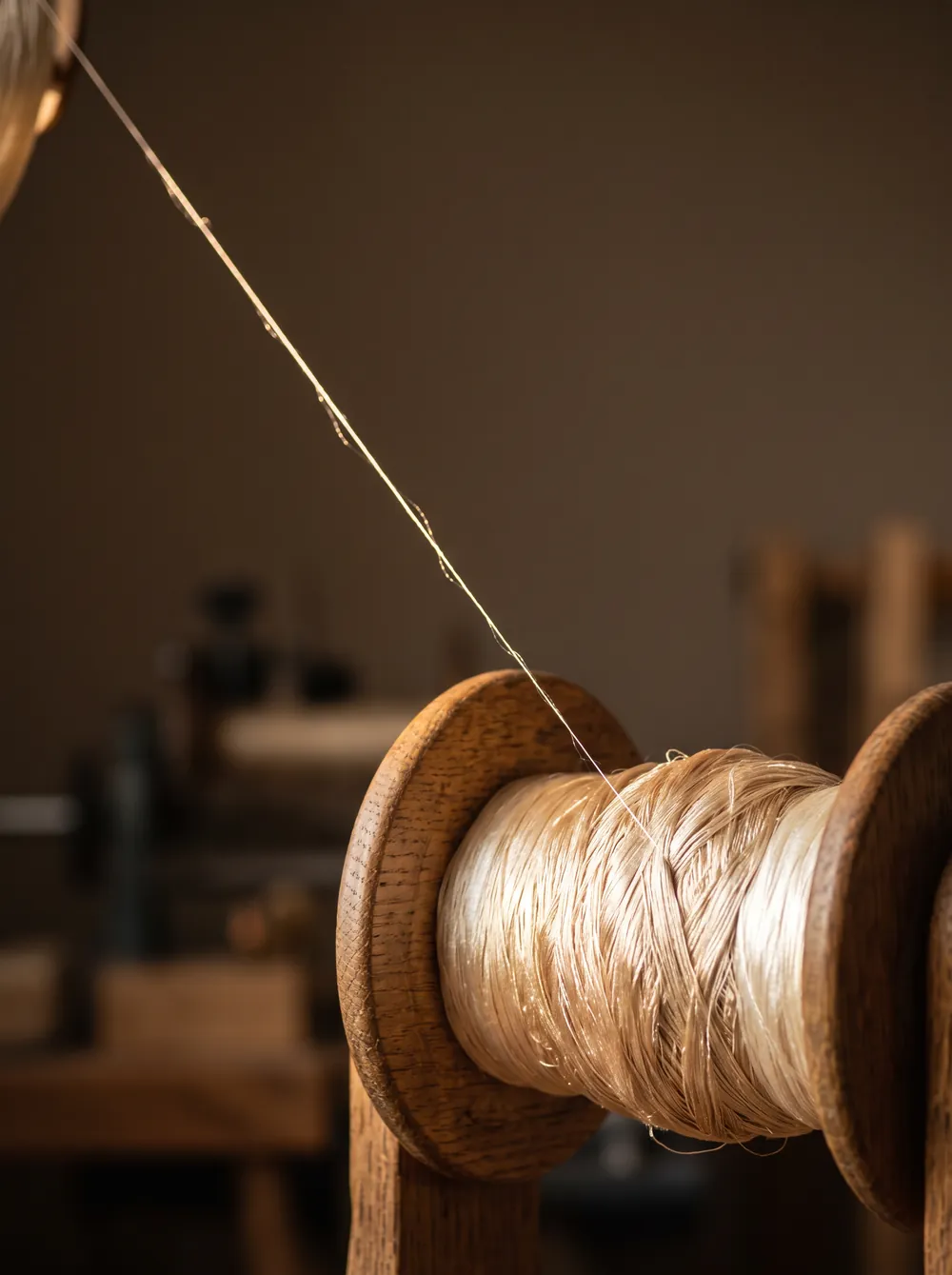
Silk is often sold as skincare you sleep on. You will read that its 18 amino acids nourish your skin, or that sericin hydrates it, but no study we found shows either. We went looking for the research behind those lines. Here is what silk proteins are, where they have actually been tested, and what we can honestly say about them.
What are silk proteins?
Raw silk is two proteins. Fibroin is the fibre itself. Sericin is the gum that holds the strands together, and it makes up about 25 to 30% of the protein in raw silk.
When people talk about silk proteins, those are the two they mean. Mulberry silk comes from silkworms fed on mulberry leaves, and it is reeled from the cocoon as one continuous filament. What reaches the loom, and then your pillow, depends on how that filament is finished.
Our guide to what mulberry silk is explains reeling, and how reeled silk differs from spun silk.
Is there sericin in a silk pillowcase?
Sericin is washed out in a process called degumming, before silk is woven into a smooth fabric like charmeuse. So a finished silk pillowcase of that kind is mostly fibroin.
That matters for two reasons. First, no study shows sericin in a fabric doing anything to hydrate skin, and in a degummed fabric the sericin has already been washed out. A claim built on sericin is built on the part that was removed.
Second, sericin is a known allergen. It was reported as a work allergen in hairdressers in the 1960s, and the specialist silk garments used in clinical studies are made sericin-free for that reason. Our post on silk and allergy covers what is known.
Do silk's 18 amino acids nourish your skin?
No study we found shows that they do.
The line usually runs that silk is made of protein, so sleeping on it must feed your skin, but nobody has tested that last step. For a fabric to feed your skin, something would have to move out of the fabric and into the skin. We found no study showing amino acids moving from a silk pillowcase into skin.
There is also the fibre itself. Fibroin, which makes up most of a finished silk pillowcase, is an insoluble fibre. It is the structure of the fabric, not a serum held inside it.
We have not found a source for the count of 18, and it does not change the answer. A list of what a fibre is built from tells you nothing about whether any of it leaves the fibre.
So the claim that 18 amino acids nourish your skin is on our list of claims we don't make, along with "feeds your skin", "rich in skin-loving proteins" and "natural collagen boost".
Is sericin good for skin in other forms?
There is some evidence for sericin in a cream. A randomised, double-blind, placebo-controlled trial published in 2012 found that a sericin cream reduced itching in people on kidney dialysis.
That was a cream, made to be put on the skin. A pillowcase is a woven fabric, and in a smooth fabric like charmeuse the sericin has been washed out before weaving. A result for one cannot be borrowed for the other, and we will not borrow it.
Laboratory work on silk proteins shows the same gap. Studies of fibroin dissolved into solutions, sericin extracts and silver-loaded silk membranes are real research, but none of them is a test of a pillowcase. In one 2022 study of silk membranes for wound healing after mouth and jaw surgery, the drop in bacteria came from the added silver, not the silk. Our post asking whether silk is antibacterial looks at that work in more detail, and finds no test of plain woven silk.
What are silk proteins used for in medicine?
Silk does have a place in medicine. A 2023 systematic review looked at medical products that contain silk, such as dressings, tissue scaffolds and underwear for gynaecological conditions. It was small, 9 studies and 346 patients, and it reported good outcomes.
None of those products was a pillowcase. A dressing on a wound or a scaffold in surgery is a very different thing from a fabric under your cheek, and the review says nothing about sleeping on silk.
It is a good example of how silk research gets stretched. A real finding about one product turns up, a few steps later, as a promise about another. The fibre section of our science page sets out what silk is, with its sources.
What does SOIEA say about silk proteins?
One plain line: silk is a natural protein fibre, made mostly of fibroin.
UK advertising rules say a business must hold evidence for a claim before it makes it, and health and beauty claims need evidence, where relevant from trials on people. No trial has tested whether silk proteins from a pillowcase nourish skin, so "nourishes", "feeds your skin" and "sericin hydrates" stay off our pages.
One fact about silk does hold up. In standard conditions, silk takes up about 11% of its weight in moisture from the air, and polyester satin takes up less than 1%. Our post on silk, cotton and moisture sets out the figures.
Silk does ask for a gentle wash. Strong alkaline detergents weaken it, so use cool water and a pH-neutral detergent with no enzymes or bleach, and dry it out of direct sun. Whatever your pillowcase is made of, wash it every week. Our guide on how to wash a silk pillowcase has the detail.
SOIEA is 100% mulberry silk at 22 momme, in champagne and blush, launching in December 2026 for the UK and Ireland. It is smooth and soft against your skin. Choose it because you love how it feels. See the pillowcase.
Questions people ask
Raw silk does. Sericin, the gum that holds the strands together, is about 25 to 30% of the protein in raw silk. It is washed out in degumming before smooth fabric like charmeuse is woven, so a finished silk pillowcase is mostly fibroin.
We found no study showing amino acids moving from a silk pillowcase into skin. Fibroin, the main protein in a finished silk pillowcase, is an insoluble fibre.
A 2012 randomised, double-blind trial found a sericin cream reduced itching in people on kidney dialysis. That was a cream put on the skin, not a fabric, and no study shows sericin from a pillowcase doing anything for skin.
No study shows that. Silk is a natural protein fibre, made mostly of fibroin, and "natural collagen boost" is on our list of claims we don't make.
In products such as dressings and tissue scaffolds. A small 2023 review of 9 studies and 346 patients reported good outcomes, but none of those products was a pillowcase.
Sources
- Aad R, Dragojlov I, Vesentini S. Sericin protein: structure, properties, and applications. J Funct Biomater, 2024
- Zhu L, Lin J, Pei L, et al. Recent advances in environmentally friendly and green degumming processes of silk. Polymers, 2022
- Aramwit P, Keongamaroon O, Siritientong T, et al. Sericin cream reduces pruritus in hemodialysis patients: a randomized, double-blind, placebo-controlled experimental study. BMC Nephrol, 2012
- Foppiani JA, Weidman A, Alvarez AH, et al. Clinical use of non-suture silk-containing products: a systematic review. Biomimetics, 2023
- Schäfer S, Smeets R, Köpf M, et al. Antibacterial properties of functionalized silk fibroin and sericin membranes for wound healing applications in oral and maxillofacial surgery. Biomater Adv, 2022
- Coats. Know about textile fibres
- Ohio State University extension. Silk fabric care fact sheet
- ASA and CAP. Substantiation for health, beauty and slimming claims
Every claim here is checked against the published sources above and our graded evidence page. We don't make claims the evidence doesn't support.
Keep reading
The fibre
What is mulberry silk, and why is it reeled not spun?
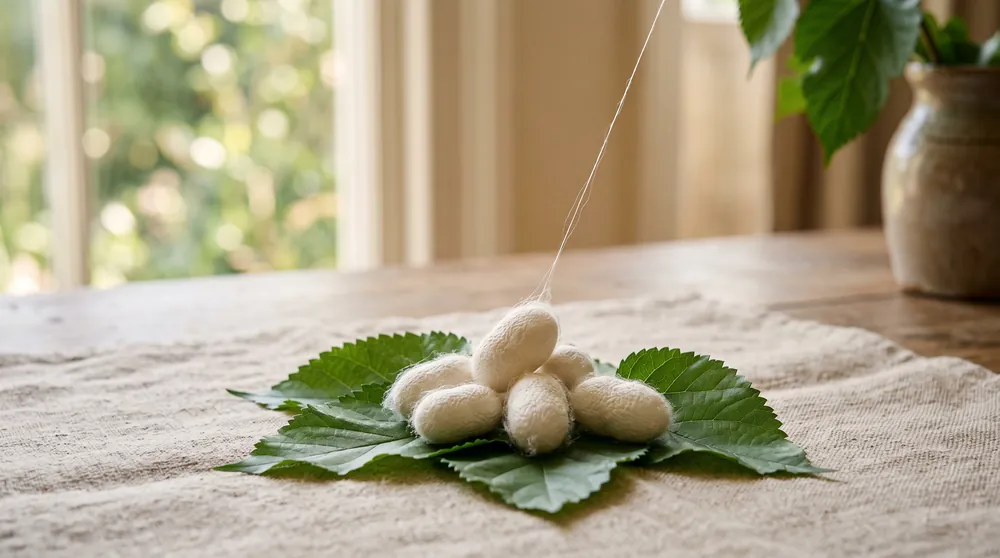
Mulberry silk comes from silkworms fed on mulberry leaves. Each cocoon is unwound, or reeled, as one long continuous filament, so the yarn has no short fibre ends on its surface. Spun silk is made from short fibres, more like cotton yarn. Silk itself is a natural protein fibre, made mostly of fibroin.
· 4 min read
The fibre
Does silk absorb less moisture than cotton? The 11% figure explained
Not from the air. In standard conditions silk takes up about 11% of its weight in moisture from the air, and cotton 7 to 11%, so silk holds as much or a little more. It holds far more than polyester satin, at 0.4 to 0.8%. No study has tested what this means for your skin overnight.
· 4 min read
The fibre
Silk vs satin pillowcases: what is the difference?
Satin is a weave, not a fibre. It can be woven from silk, but most low-cost satin pillowcases are polyester. Both are smooth, and dermatology guidance for curly hair says satin or silk, not one over the other. The clearest measured difference is moisture: silk takes up about 11% of its weight from the air, polyester under 1%.
· 4 min read
Be first to sleep on it.
22 momme mulberry silk, launching December 2026. Shipping to the UK and Ireland.
Join the pre-order list